Designing Aurora’s first commercially ready autonomous freight system delivering goods on America’s roads.
Aurora Freight — Trucking is a $700B industry in the U.S. Nearly everything we own has traveled on the back of a truck. Aurora is on a mission to build the safest driver of the future by automating middle-mile delivery. In partnership with Peterbilt, Kenworth, Volvo, and Continental, we’re developing the world’s first scalable autonomous trucking platform.
How might we design autonomous vehicle hardware that is safe for public roads, adaptable across platforms and fleets, efficient and cost-effective to operate, and desirable and approachable to the public?
Hardware and physical touchpoints required to commercially deliver autonomous trucking solutions to businesses and partners.
-
Commercially launched a fleet of self-driving trucks delivering customer goods in Texas.
-
Established Autonomy Enabled Trucks with OEMs and Tier 1 manufacturer to industrialize the Aurora Driver.
-
30% improvement in aerodynamic efficiency on the Aurora Driver Kit compared to its predecessor—contributing to $1M reduction in fuel costs annually in a 1,000 truck fleet.
-
John Paxton, Albert Shane, Wayne Jackson and many many more.


First step towards safety is ensuring the truck is able to see the world clearly — sensors are strategically positioned to maximize the driver's visibility and clustered them into pods.


Learning to walk, crawl and run all at the same time — Going from putting pencil on paper to industrializing the production of Autonomous vehicles over 4 years.

01 Show the vision
Concept truck
The newly formed Aurora Industrial Design team designed and showed our vision of what the future self-driving trucks might look like. The two trucks were debuted at the American Trucking Association Convention, and demonstrated what a scalable, cross-platform might look like. This helped solidify Aurora's partnership with PACCAR, which holds 30% of the U.S. trucking market.

02 Prove it's real
Minimum viable product
Demonstrate and prove the product works — In 2025, Aurora launched commercial operations with Uber Freight on the Dallas–Houston corridor, delivering a limited fleet of roadworthy autonomous trucks and the terminals and physical infrastructure required to operate a fully functional self-driving middle-mile network.

03 Make money each mile
Scale
To validate scalability and business viability, we partnered with OEMs to standardize Autonomy Enabled Trucks, enabling safe, plug-and-play hardware integration. We also drove major hardware optimizations, including a 30% aerodynamic efficiency improvement on the Aurora Driver Kit, delivering meaningful reductions in operating costs.

04 Industrialize the Aurora Driver
Systemizing the production of AVs
In partnership with Continental and our OEMs, we’re developing the Aurora Driver as a scalable, automotive-grade product ready for commercial deployment, supporting Aurora’s long-term goal of nationwide autonomous trucking. This work is actively underway with our partners.
Driving partner alignment and sign offs through design — Upfitting legacy OEM Class 8 trucks is not an easy challenge both technically and emotionally.

Learning 1
Deep hardware and platform integration builds partner confidence
We took a deliberate approach to structurally integrate to Aurora hardware kit to the platform. This carved a path towards designing and defining Autonomy Enabled Trucks.
Learning 2
Platform agnostic design lowers barrier for new partnerships
The common design strategy allowed Aurora Driver to be integrated to multiple platforms without skewing to strongly to one OEM or the other.
Learning 3
Great aerodynamics unlock customer buy-in from the get-go
Efficient aerodynamics is an important feature for OEMs. Fuel efficiency is a key performance metric and selling point for customers and OEM partners.
Learning 4
Build in H/W and design provisions for changes down the road
Self driving is an advanced technology industry that is interdependent on wide range of partners, industries and adjacent technologies.


Defining and evolving Aurora's physical design language to bring together customer touchpoints, brand and user experience goals — Humanizing highly technical offering.


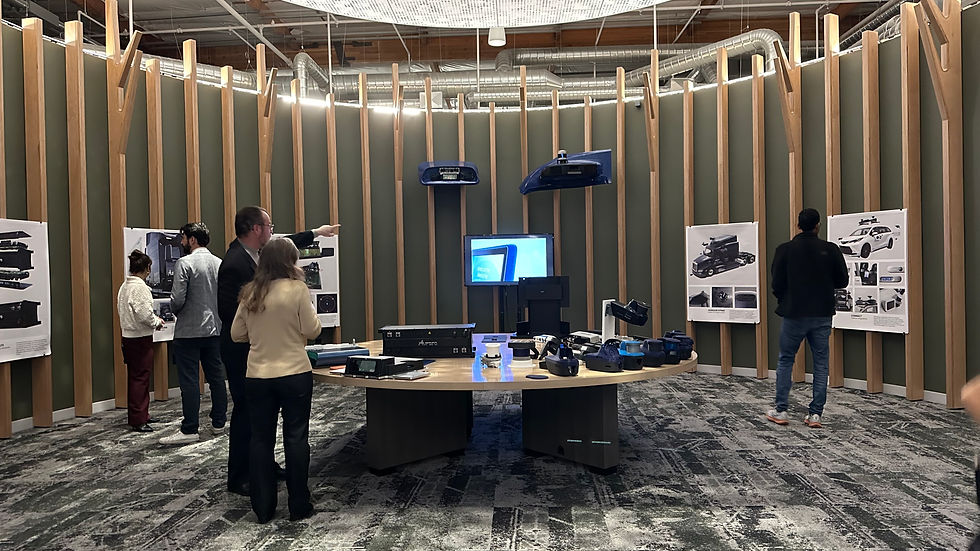
Using rapid prototypes to move quickly — Conversations become more clear and meaningful when there is something to point to.


Working closely with cross functional partners to protect design intent, negotiate and drive design integration into vehicle programs — ME, VIT, CAE, PM, TPM, BD, Marcomm, PD, Legal, OEM Partnership.


Sharing our progress to build awareness and bridge the knowledge gap across teams within the organization.
Commercial launch — In April 2025, Aurora commercially launched the Aurora Driver autonomously hauling customer freight between Dallas and Houston, Texas. Backed by customers like Uber Freight, Werner, FedEx and many more, this milestone marks the first commercial deployment of an autonomous 18-wheeler freight service in the United States.


Exterior HMI
The exterior visual state indicator (light bar) is a safety-critical communication tool enabling trucks to communicate it's states to people around. With key colors and simple sequences, it signals whether the vehicle is safe to approach, and acts as a modern emergency triangle when stopped on highways.
Contributions :
Defining key functionalities of the light bar based on real-world safety needs.
Identifying optimal placement for clear visibility and quick recognition.
Developing light behaviors to communicate effectively with terminal operators and nearby pedestrians.


Interior HMI
The interior HMI enable terminal and vehicle operators to bring up the Aurora Driver, engage and disengage from autonomy. Input and feedback needs to be clear and in sync with the platform information and consistent across different platforms.
Contributions :
-
Interactions and feedback for safe and intuitive engagement during the bring up process.
-
Building consistency across NVO and VO autonomy engagement procedure to lower learning curve.
-
Aligning OEMs on implementation of Aurora interface to build interaction consistency in a multi-platform fleet.
-
Provisioning for future features on next generation Autonomy Enabled Truck platforms.


Vehicle UX + Information architecture
The vehicle’s information architecture is a system that ensures external actors, such as first responders, inspectors, and service partners, can quickly and safely engage with Aurora’s autonomous trucks. It provides the information needed for rescue operations, service interactions, and compliance with USDOT regulations, while guiding people to the exact locations or access points they may need.
Contributions
-
Built inspection workflow and structured the information needed for externals to engage with driverless vehicles during off-nominal cases.
-
Service hotline feature to support external member engagements.
-
Executing and implementing the information on a fleet of trucks.


Documentation + Regulation compliance
Every freight transport trip requires documents regarding the trailer and tractor that needs to be presented to law enforcements if the truck gets pulled over. It is required to carry physical copies of the documents and allow the officer to inspect the cabin if needed.
Contributions :
-
Defining the placement of document and key lockbox for external actor engagements.
-
Sourcing off-the-shelve security mechanisms to store and protect documents and key to the cabin.

Vehicle service and maintenance optimization
The work focused on learning from terminal operations to optimize the service and maintenance of Aurora hardware, embedding these insights into ongoing and future hardware development.
Contributions :
-
Translating operational learnings into hardware features that improve serviceability and maintenance efficiency at scale.
-
Proposing workflow improvements to streamline vehicle inspection and mission preparation.
-
Refining A-surface geometries and integrating sensor-cleaning solutions informed by real-world service and environmental conditions.


