Next generation diabetes management system to support patients navigate their journey with confidence and clarity.
Medtronic Diabetes—over the course of 1.5 years, our team worked closely T1 and T2 diabetes patients to design a new generation diabetes management system that respects their pre-existing mental models and people can trust. The system of products included, tethered insulin pump, patch pump, CGM (Continuous Glucose Monitor), infusion set(s), consumable insertion devices and the key moments in the mobile App that enable patients to connect, navigate and control their therapy.
Designing Medtronic's next generation diabetes management platform to empower and support patients navigate their health journey with clarity and confidence.
Rigorous concepts and user informed design recommendation on Medtronic's next generation tethered and patch pump, infusion set, CGM and mobile app.
Put user voice at the forefront to encourage user centered decisions and form Medtronic's product strategy that would positively impact millions of diabetes patient that it serves.
Thomas, Zahin, Mike, Min, Jesse, Dogan, Ross, Isabella, Chase and many more.
September 2020 - February 2022

4 programs centered around insulin delivery for patients with T1/T2 diabetes.

Program 1
Closed loop insulin pumps
We helped design Medtronic’s next remotely controlled insulin pump platform, exploring how both tethered and patch pumps, managed mainly through a mobile app, could better fit into the everyday lives of people with Type 1 and Type 2 diabetes.

Program 2
Infusion set and sensor serter
We immersed ourselves in the product context, created and prototyped concepts, gathered feedback from people with diabetes, and refined our ideas. We shared our recommended design for the on-body sensor/infusion set, tubing clip, serter, and tubing packaging—along with alternative options for future consideration as development continued.

Program 3
CGM sensor and serter
We prototyped concepts, gathered feedback from eight people with diabetes, and refined our ideas. Our recommended CGM and serter design focused on form factor to build confidence during insertion, reduce fear of needles, ensure proper orientation, and make the sensor as discreet as possible.

Program 4
Therapy management app + physical user interface
1) We continued to refine the tethered pump hardware design and further tested and validated with users for high-fidelity refinement, and 2) designed the mobile app experience and key moments from the ground up focused and in respect to the tethered pump.


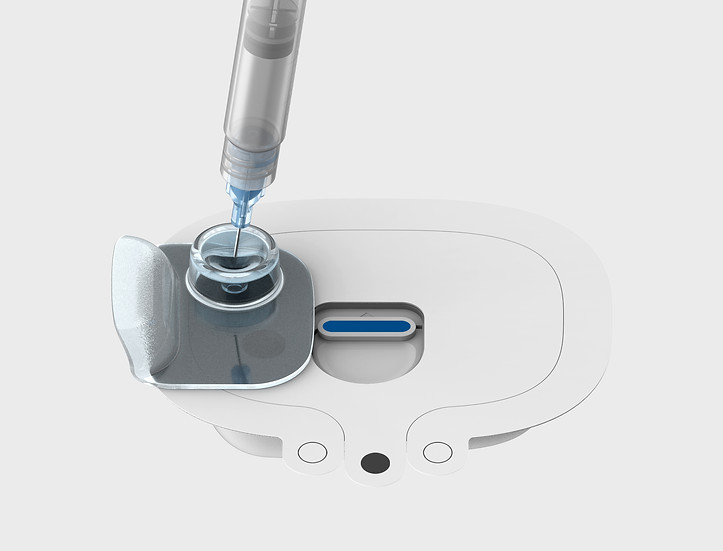


We started the programs by speaking with the people whom we are designing for—the patients. Sacrificial concepts were used as tools to spark conversations and test our hypothesis before diving into the solutioning.

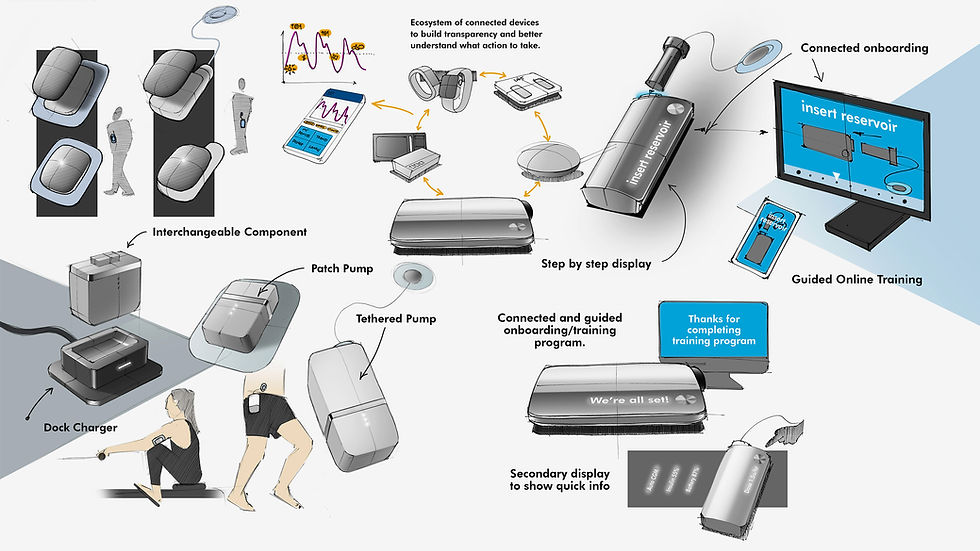


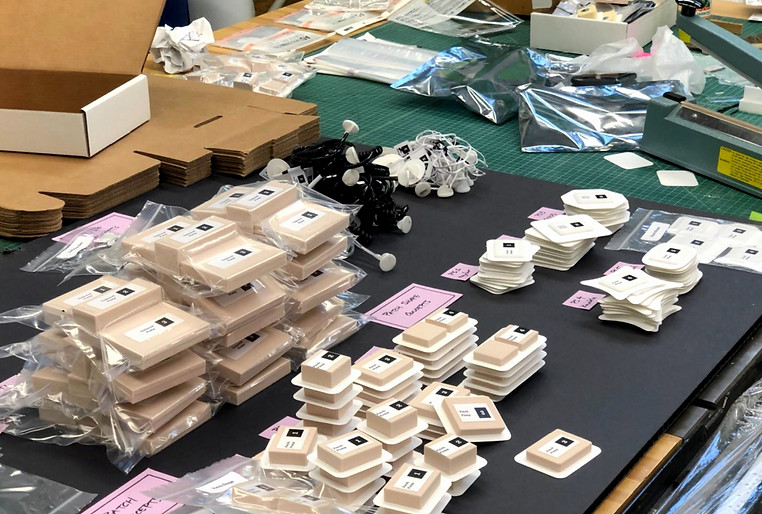
These conversations uncovered key insights into patients’ daily lives and attitudes, shaping the direction of our investigation.

Learning 1
Diabetes requires making tradeoffs, and people lean towards whatever makes life more ‘normal’.
Learning 2
Easy & continuous access to reliable data is the difference between dealing with diabetes and thriving with it.
Learning 3
When diabetes is controlling your life, deciding when to disclose your diagnosis is empowering.
Learning 4
People feel a constant tension between craving independence and needing help at times.
Learning 5
Parents transition control over time based on their child’s individual capabilities and biological needs, not their age.
Learning 6
Endocrinologists can be better partners when they have easy access to relevant information.
Opportunity Areas — Building on insights from our first round of interviews, we expanded the opportunity space and explored how these learnings could inform and shape our concepts.

Opportunity Area 1
Creating breaks that don't require taking the insulin pump off.
➔ HMW design integrated consumables to streamline insulin pump management?
➔ HMW design alarms/notifications/interactions thoughtfully to enable patients to forget about their pump even so briefly?
Opportunity Area 2
Enabling flexibility for a diverse population with dynamic needs.
➔ HMW design experiences to enhance patient and pump compatibility? (skin/adhesive compatibility, lifestyle, attitude towards diabetes etc.)
➔ HMW design with modularity in mind to add value to the evolving patient needs?
Opportunity Area 3
Supporting the path to independence for kids with diabetes and their families.
➔ HMW design age-appropriate interactions that celebrate the successful management of diabetes?
➔ HMW design an insulin pump with sleeping comfort in mind so the pump doesn’t add to the stress of an interrupted night?
Opportunity Area 4
Fusing Medtronic’s innovations with user expectations.
➔ HMW enable patients to seamlessly control, and manage their diabetes through multiple points of interaction?
➔ HMW maximize patients ability to access, glance and process their data discreetly?
User inspired design principles were used as a beacon throughout the decision making process.

Design Principle 1
Create opportunities to develop a better routine.
Design Principle 2
Design to optimize the use of insulin and limit waste.
Design Principle 3
Remove the burden of machine management.
Design Principle 4
Provide system solutions not a standalone product.
Design Principle 5
Maximize lifestyle choices to allow people to do and wear what they want.
Design Principle 6
Create options for redundancy so no one is denied what is needed.
Design Principle 7
Empower direct user control and provide options to set goals.
We worked closely with research participants—testing, validating, and gathering tangible feedback—to continuously refine and evolve our ideas and concepts.


Reducing snagging + providing tactile feedback
Design iterations focused on reducing clip size and removing straight edges to prevent snagging and injury, adding tactile feedback for confirmation without looking, and shaping surfaces for easier grip, especially for users with reduced fingertip sensitivity.

Integrating consumables into the setup workflow
Integrating the consumable workflow into the therapy experience is critical, as setting up the system involves multiple consumables and steps, where mistakes can disrupt treatment.

Proper adhesion determines longevity
The adhesive acts as a critical user interface—“insulin is gold,” proper adhesion determines device longevity and reduces the need for extra bands or reinforcements.

Discrete and intuitive user interface
The Physical User Interface needs to be discrete and intuitive to control. Moving the screen interface shifted from the pump to the mobile app meant critical controls, alerts and notifications needed to remain on the pump. Extensive research defined which features and communications must stay on the pump and how to deliver them clearly and intuitively.

Provide clear sense of directionality and orientation
Directionality is crucial, as user lifestyle and preferences shape how infusion sets or sensors are placed and routed. This is a decision patients have to live with for days.

Reducing the mental burden on needles
Patients need to live with the pain of needles going through the skin. Work to reduce fear, perceived pain and mental burden of needles was critical.
Recommendations focused on elevating the user’s voice and grounding decisions in user-driven insights.
_gif.gif)

To explore how alerts and notifications should be perceived on the skin, we prototyped wearable bands with sequenced audio and tactile cues, shipped to participants, and activated by pulling a tab on the side.

User explaining the setup and the importance of directionality and correctly routing the infusion tube to support user's needs and lifestyle.

In exploring physical interaction and form factor, we focused on minimizing human error by making notifications and alerts easy to distinguish, while giving users the discretion to snooze or act when needed.

Form factor and orientation weren’t on our radar at first, but this insight pushed us to rethink how people actually carry the device.

To explore how alerts, notifications and feedback show up across physical and digital touchpoints, we created a digital prototype to show how a pump and the mobile app could work together.
Recommendations focused on elevating the user’s voice and grounding decisions in user-driven insights.


